|
Pest or Disease ProblemsPest or disease problems can affect many plants, particularly those under environmental stress. Kernock Park Plants practices Integrated Pest Management (IPM) techniques for the control of pests and diseases on the nursery – utilising cultural techniques, biological control agents, biological insecticides and bio-fungicides, and where required, selective or short-persistence pesticides and fungicides.
In most circumstances, good ventilation in greenhouses and polytunnels will significantly reduce disease issues. Avoidance of instances of under-watering and over-watering will also help in the production of healthy, resilient plants. Overhead watering of plants should ideally be limited to days and times when foliage will dry quickly, and certainly before nightfall.
Early identification of pests will help in achieving good levels of control. The following information provides a brief introduction to the topic. |
|
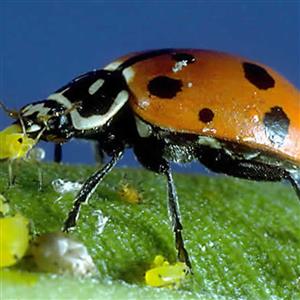
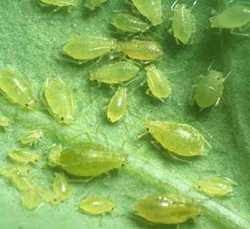
AphidsAphid populations can increase rapidly due to parthenogenesis (asexual reproduction) and viviparity (birth of live young), and because their young are already pregnant when born. The exudate from their feeding results in sticky residues on foliage and stems, upon which sooty moulds may also develop. The parasitic wasps Aphidius ervi and Aphidius colemani, and the predatory midge Aphidoletes aphidimyza will control most aphid species. Larvae of lacewing Chrysoperla carnea will devour most aphid species. They will also feed on pests such as leafhopper nymphs, mealybug, scale insects, spider mite, thrips, and whitefly. Larvae of naturally occurring ladybirds (Coccinella spps.) are likewise voracious predators of aphid. |
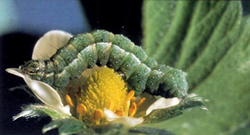
CaterpillarThe caterpillar of Tortrix moth spps. can be controlled with sprays of the biological insecticide Bacillus thuringiensis. Pheromone lure traps can be a useful addition to IPM programmes - they are usually specific for each species of moth and will attract moths from a wide radius and often provide a degree of pest control. The parasitic wasp Trichogramma spps. will parasitise eggs of most moth species. |
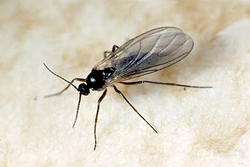
Sciarid fliesFor sciarid fly Bradysia difformis control and prevention in propagation areas and structures where newly potted plants are kept, applications of the predatory mite Hypoaspis miles are useful. The predatory mite also feeds on thrip larvae/pupae and mealybug nymphs. Applications of entomopathogenic nematodes will also provide curative activity against sciarid larvae. Yellow sticky traps laid horizontally, sticky side up, will trap adult flies and can be used as an indicator of pest presence as well as providing some level of control. |
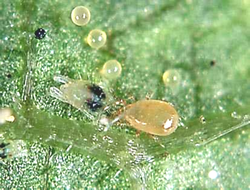
Spider mitesTwo-Spotted Spider Mites Tetranychus urticae can survive throughout the year on a wide range of plants producing their characteristic yellow speckling feeding damage, and in significant infestations, webbing. There are a number of predatory mite options for control including Amblyseius andersoni, Amblyseius californicus, and Phytoseiulus persimilis. |
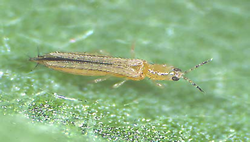
ThripsThrips Thysanoptera spps. can be a significant pest on many crops and may help spread viruses - Western Flower Thrip (WFT) and Onion Thrip are the main species involved, although cereal thrips can also cause damage in late summer. Thrips feed by rasping the leaf surface leading to distorted growth and loss of colour from flowers. The pest may be controlled by preventative applications of predatory mites such as Amblyseius cucumeris. For heavier infestations, the predatory bug Orius laevigatus will feed on all stages of the pest. Alternatively, parasitic nematodes such Steinernema feltiae can be used to kill adults and larvae/pupae. |
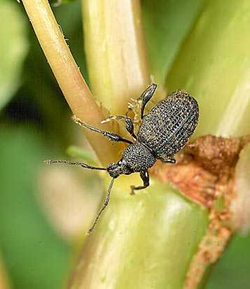
Vine weevilVine Weevil Otiorhynchus sulcatus adults feed on leaf margins, causing characteristic regular notching usually at modest levels and cosmetic in nature. However, their larvae can cause serious damage to plants by feeding on roots. Please note that there is no longer a persistent, long-term control for this pest. Ongoing control measures are required when plants are growing on your nursery. Use of growing media incorporating the biological insecticide Metarhizium brunneum will provide a base level of control. However, repeat applications of parasitic nematodes such as Heterorhabditis megidis and Steinernema kraussei from June until end of October are also required to achieve anything close to full control. |
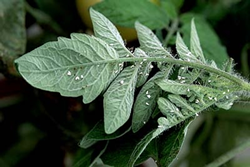
WhiteflyWhitefly Trialeurodes vaporariorum are sap-sucking pests and can attack a wide range of edible and ornamental plants, producing sugar-rich secretions upon which sooty moulds may form. Regular introductions of the parasitoid wasp Encarsia formosa are the usual method of biological control for this pest. |
CONCLUSIONThe key element in a successful, sustainable IPM programme is to prioritise use of cultural techniques; as a second tier of control, beneficial insects (biological control agents) and biological insecticides will keep pest populations low and can sometimes eradicate the targeted pests completely. As a final and third tier of control, selective pesticides can be integrated to control troublesome 'spike' outbreaks. |

 Plant Finder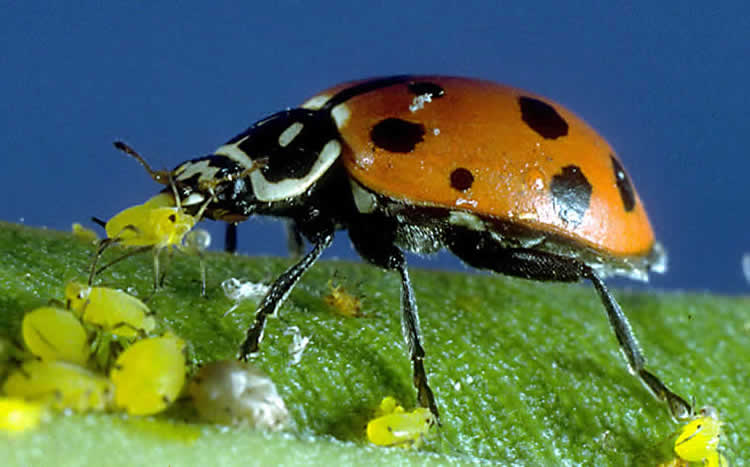
 +44 (0)1579 350561
 sales@kernock.co.uk